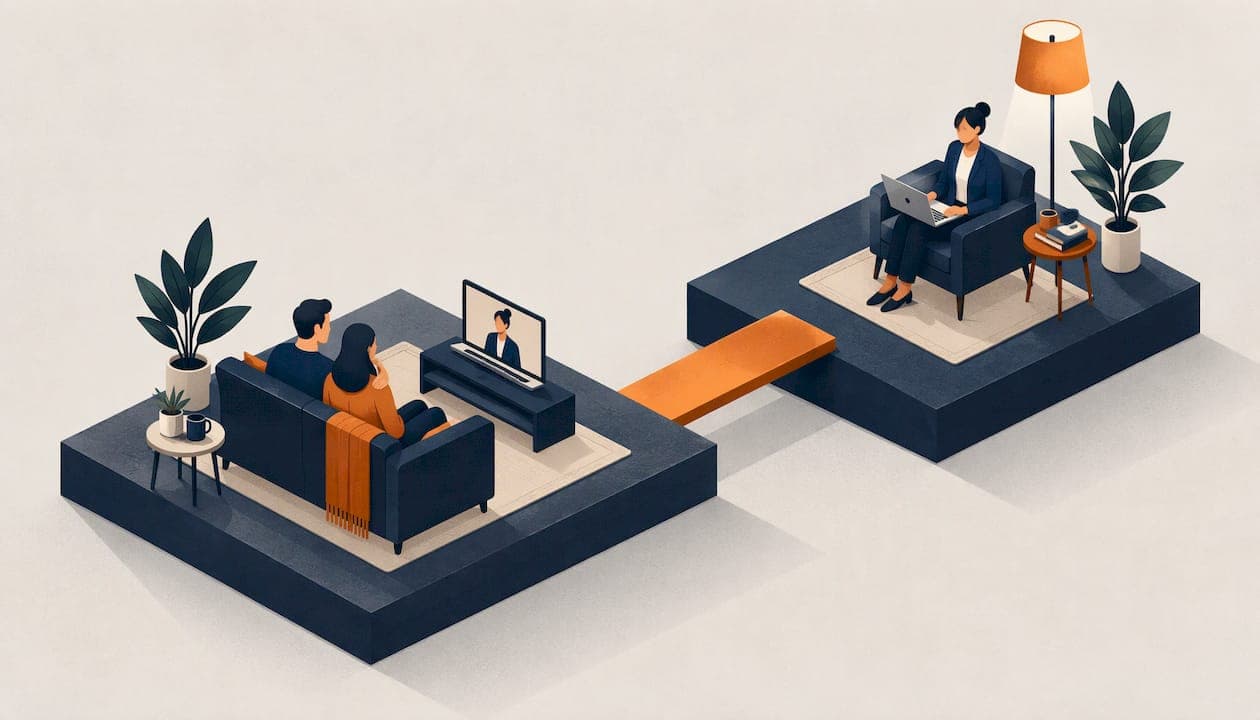
Telehealth couples counseling is regular couples work done over secure video, with both partners on screen and a licensed professional guiding the conversation. Research so far points to outcomes comparable to in-person sessions for many couples, as long as the setup is private, the provider is licensed where you live, and the format suits your situation. This guide covers what the evidence says, how a session runs, what to arrange at home, where confidentiality has limits and how to choose well.
TL;DR
- Studies of videoconferenced couples therapy report improvements in relationship satisfaction similar to face-to-face work, though researchers say more study is needed.
- A session looks like an in-person one: both partners, one screen each or one shared screen, a structured conversation and clear next steps.
- Privacy at home is a shared job. Agree on a private room, a device, and a time-out signal before the first session.
- Check that your counselor is licensed in the state where you are sitting during the session, and that you receive a written informed consent.
- We offer private, time-bound telehealth couples counseling for Colorado couples at $100 per couples session.
Table of Contents
- Does telehealth couples counseling work?
- How an online couples counseling session works
- Setting up your space
- Privacy and confidentiality on video
- When video may need extra support
- Telehealth, licensing and where you sit
- How to choose a telehealth couples counselor
- Work with us in Colorado
- FAQ
- Sources
Does telehealth couples counseling work?
For most couples, the research is encouraging. In a randomized trial of 30 couples, relationship satisfaction, mental health and other outcomes improved over time, and results did not differ between videoconferencing and face-to-face delivery. Ratings of the bond between couple and therapist did not differ either. The authors call videoconferencing a viable alternative and note that further research is needed.
Larger data points the same way. A 2024 study of 1,157 married clients found teletherapy was as effective as in-person therapy at improving outcomes. It also found that the therapeutic alliance grew faster in person, which is a reason to be deliberate about building rapport on screen: speak directly, stay engaged, and give the first few sessions your full attention. The setting where therapy happens also played a role in effectiveness, regardless of modality.
A 2021 meta-narrative review in the Journal of Family Therapy concluded that structured, cognitive-behaviorally oriented synchronous digital couple and family interventions are feasible, work with diverse populations and show clinical outcomes similar to in-person psychotherapy. And a 2025 meta-analysis of digital relationship interventions found a significant, moderate effect on relationship satisfaction across six studies. The most consistent gains came from programs that targeted relationship satisfaction directly and included structured support from a coach.
What does that mean in practice? Structure matters. Couples tend to do best when the work has a clear goal, a defined timeline and someone steering. That is the logic behind how we run our engagements.
How an online couples counseling session works
A telehealth session follows the same rhythm as an office session. The difference is the room, not the method.
- Scheduling and consent. Before the first session you receive the link to a secure video platform and a written informed consent. Professional guidelines say consent should cover the risks and benefits of teletherapy, the counselor's licensure, how to report complaints to a licensing body, and how technology failures and emergencies are handled (AMFTRB teletherapy guidelines).
- Intake and fit check. The first conversation covers what brought you in, what each of you wants and whether video is a good fit. One published recommendation is a short pre-treatment screening with each partner separately to confirm telehealth is suitable and that there are no safety concerns.
- Working sessions. Both partners speak to the counselor directly, with a firm no-interrupting rule. The counselor slows the exchange, names patterns and gives you a different way to say what you have been trying to say.
- Between-session practice. Expect a small, specific assignment: a conversation structure, a check-in routine or a boundary to try.
- Progress review. In a goal-focused engagement, you check against the targets you set at the start, so you can see whether the work is moving.
Sessions are commonly about an hour, though length varies by provider. Ask your counselor about the exact format when you book.
One screen or two?
Most couples share one device on a couch or at a table. That keeps body language visible and feels closest to an office. If you are traveling, in different cities or too tense to sit together, separate devices and separate rooms can still work, but tell your counselor beforehand so the session can be set up for it. Your counselor should also know where each of you is located, because that matters for licensure and for emergencies.

Setting up your space
Good setup removes most of the friction people expect from video. The National Board for Certified Counselors recommends a steady device with a large screen, the camera at eye level, both partners fully visible in the frame and enough light on your faces without a bright window behind you.
A short checklist:
- Device: a laptop or tablet on a stable surface, not a phone held in hand.
- Camera: eye level, with both of you in frame from the shoulders up.
- Light: a lamp in front of you, not behind.
- Sound: a quiet room, doors closed, notifications off.
- Network: test your connection and have a backup, such as a phone hotspot or a plain phone call number.
- Seating: close enough to be seen together, far enough that you can look at each other when asked.
Do a two-minute test call before session one. It saves the first ten minutes of the appointment.
Privacy and confidentiality on video
Confidentiality in telehealth rests on two things: the provider's technology and your own space. Clinical guidance recommends end-to-end encryption and properly protected hardware and software. The same paper notes that headphones, a common privacy tool for individual clients, do not help much when two people share a session. Its authors also stress informed consent at the outset: clients are the primary party responsible for protecting privacy in their own home, and brainstorming how to do that is essential.
For couples in public life, that second part deserves real thought. Practical steps:
- Pick a room with a door that closes and no smart speakers or cameras that record.
- Use a device you control, not a shared work laptop or a corporate network that may log traffic.
- Keep the session link out of calendars that assistants or colleagues can see, or label the entry generically.
- Decide in advance how you will handle a knock at the door or a household member walking in.
Where confidentiality has limits
No counselor can promise absolute secrecy. Professional ethics codes ask therapists to tell clients about the significant exceptions up front, including child abuse reporting, elder and dependent adult abuse reporting, and clients who are dangerous to themselves or others. The code also asks therapists to protect client records and to consider whether telehealth suits each client's needs. The AMFTRB guidelines add that consent should address confidentiality limits in electronic communication, technology failure, emergency procedures and the conditions under which teletherapy may end. A good provider walks you through all of this in plain language before you begin.
One structural point matters to our clients: private pay. When you pay directly, there is no insurance claim and no diagnosis code filed with a third party for the purpose of reimbursement. That is how we keep the paper trail small.
When video may need extra support
Telehealth suits many couples, but a responsible provider checks fit before starting and keeps checking. The Hogan review points out that the biggest difference from the office is control over the room: it is harder to interrupt an escalating exchange or manage disruptive behavior through a screen, so the practical answer is to set expectations and ground rules before problems appear.
For high-conflict couples, the same research literature suggests agreeing on a time-out signal at the very start of therapy, and in more serious situations having the therapist confirm your physical location every session so emergency services can be reached if needed. The AMFTRB guidelines also direct therapists to assess the remote environment for its effect on efficacy, privacy and safety.
If you feel unsafe with your partner, or there is any physical violence, tell the counselor privately and do not rely on a joint video session to address it. In an emergency, call 911. You can also reach the National Domestic Violence Hotline at 1-800-799-7233.

Telehealth, licensing and where you sit
Licensing is the question couples most often skip. The AMFTRB guidelines state that therapists working across state lines must comply with the laws and rules of both jurisdictions, and that informed consent should include licensure qualifications and how to file a complaint with a licensing body. The AAMFT's telehealth guidelines note that early research is promising, while legal recognition of telehealth keeps evolving and many clinicians lack basic knowledge of their obligations.
So before you book anyone, ask:
- Which state licenses do you hold, and are they active for the state where I will be during sessions?
- What platform do you use, and how is it secured?
- What does your informed consent cover, and may I read it before the first session?
- What is your emergency procedure if the connection drops or someone is in crisis?
- How do you measure progress?
A provider who answers those cleanly is one you can trust with the rest.
How to choose a telehealth couples counselor
Beyond licensure, match the format to your life. Here is how the main options usually compare:
| Criterion | Open-ended weekly therapy | Time-bound, goal-focused engagement |
|---|---|---|
| Structure | Evolves session by session | Goals, milestones and progress updates set at the start |
| Duration | No fixed end | Defined window, such as three months |
| Payment | Often insurance-based | Can be private pay |
| Fit for busy schedules | Depends on provider | Built around limited availability |
| Record trail | Insurance claims and diagnosis codes | Minimal if private pay |
There is no universal right answer, but the research above suggests that clarity of goals and structured support are what separate engagements that produce visible change from those that drift. Look for a counselor who can tell you, in the first conversation, what success looks like for the two of you and when you will check it.
Our perspective
We built this practice for couples whose lives leave little room for slow, open-ended therapy: executives, military leaders and public figures who are good at running things and still find it hard to be understood at home. For them, telehealth is not a compromise. It is what makes consistent work possible between travel, deployments and demanding calendars.
Our approach is a three-month engagement with clear goals, measurable targets and progress updates along the way. We designed it that way because clarity is what high-capacity people respond to. You know what you are working on, you can see whether it is moving, and the engagement ends rather than renewing by default.
Privacy is part of the design too. We work private pay, with no insurance involved, and we use secure telehealth so a difficult conversation stays between you, your partner and us. Our background in military leadership and therapy shapes how we work with people who carry a public role and a private strain at the same time.
Our advice is simple: do not wait for a crisis to start. The couples who benefit most are the ones who begin while there is still goodwill to work with.
Uniworld
Work with us in Colorado
We offer private couples counseling by secure telehealth for high-profile and high-capacity couples in Colorado, with immediate access and a three-month, goal-focused structure. Each couples session is $100. If the pressure point is a specific one, we also work on conflict that keeps repeating, recovery after infidelity and premarital preparation for engaged couples.

You can see everything we offer and get started on our main page. If you would like to read how we think about the patterns couples get stuck in, our Letters to Couples are a good place to begin.
FAQ
Is online couples counseling as effective as in-person?
For many couples, studies find similar outcomes. A 2024 study of married clients found teletherapy as effective as in-person therapy, though the bond with the therapist developed faster face to face. Research is still growing, and results vary with the couple and the format.
Can we do telehealth couples counseling from different locations?
Often yes, if you tell your counselor in advance. Each of you needs a private space and a stable connection, and the counselor needs to know where each of you is during the session. Licensing rules apply to the state where you are located, so confirm that before booking.
How private is a video session?
Privacy depends on an encrypted platform and a private room on your side. Counselors explain the legal exceptions in their informed consent, such as reporting child abuse or serious danger. With private pay there is also no insurance claim tied to your sessions.
What should we do before the first session?
Test your device, camera and connection, choose a closed room, and put both of you in the frame with good light in front of you. Talk beforehand about what each of you wants from the work and agree on a time-out signal in case a conversation gets heated.
Sources
- Couples Therapy Delivered Through Videoconferencing (randomized trial, 2022)
- Call me maybe? In-person vs. teletherapy outcomes among married clients
- Synchronous digital couple and family psychotherapy review
- Effectiveness of digital interventions on relationship satisfaction
- AMFTRB teletherapy guidelines
- Conducting Couple Therapy via Telehealth: Special Considerations
- NBCC: navigating the challenges of counseling couples virtually
- Clinical and Ethical Considerations for Delivering Couple and Family Therapy via Telehealth
- CAMFT Code of Ethics
- AAMFT Best Practice Guidelines for Telehealth in Couples and Family Therapy